
Introduction
When you’re sourcing straws at volume—whether for a café chain, bubble tea brand, commissary kitchen, or distribution business—small specification choices quickly become operational problems. A straw that’s too soft collapses in thick drinks; a straw that’s too long won’t fit the lid; the wrong packing format can slow service and create hygiene risks.
So buyers often start with one question: which Plastic Straw Manufacturer Malaysia can consistently supply the right PP straw specification, packing format, and documentation for food-service use—at the quantities you actually order?
This guide breaks down polypropylene (PP) straw specs, food-contact checks, and bulk ordering details to help you reduce complaints, rework, and last-minute procurement.
Why PP straws are still widely specified for food-service
PP straws remain common in beverage service because they balance rigidity, usability, and cost for high-throughput operations. They’re familiar to staff and customers and perform reliably in cold drinks with ice and typical service conditions.
- Rigid enough for service: PP generally holds its shape during stirring and repeated sipping.
- Pack-format flexibility: Commonly available in sleeves, individual wraps, or bulk packs.
- Consistency for daily operations: Predictable performance matters as much as unit price when you consume cartons weekly.
However, PP straws aren’t interchangeable. The specs below are what drive real-world performance.
PP straw specifications that affect drink experience (and complaints)
Most “bad straw” complaints trace back to diameter, wall thickness/rigidity, length, or cut/finish. Standardising these across your menu and cup range prevents repeat issues across outlets.
Diameter (ID/OD) and what it means for flow
Diameter controls flow rate and whether inclusions can pass through. Match it to your drinks:
- Standard drinks (water, soft drinks, iced coffee/tea): regular diameter for comfortable sipping.
- Thicker drinks (milkshakes, smoothies, chocolate drinks): wider diameter to reduce suction effort.
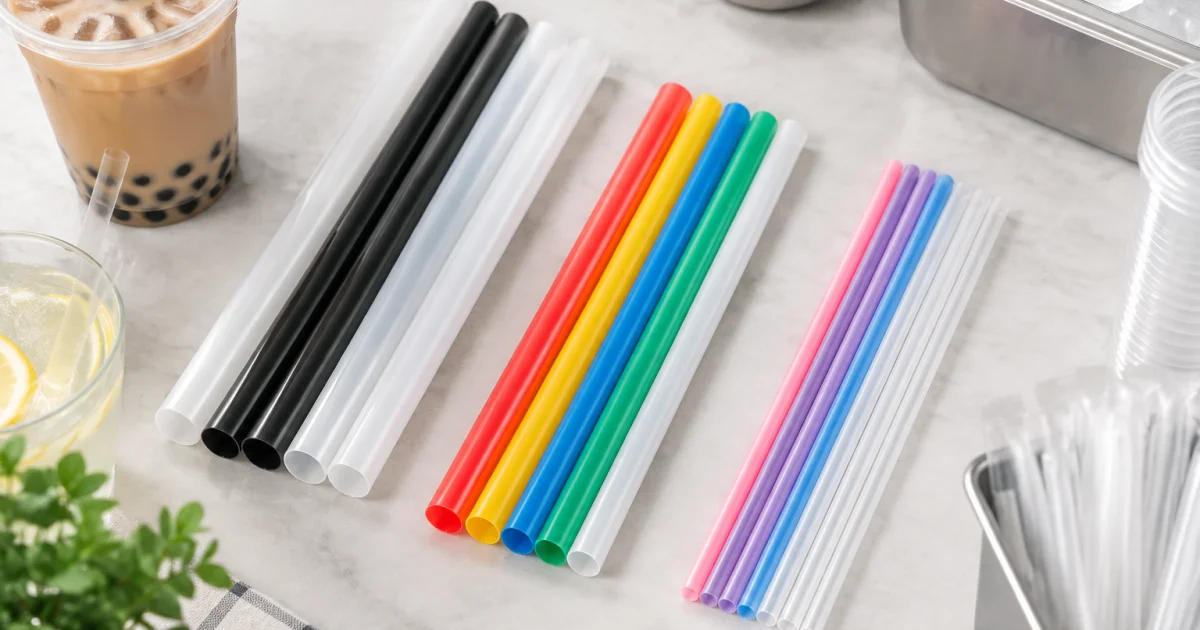
- Bubble tea / toppings (pearls, jelly, popping boba): large diameter to prevent clogging.
Buyer tip: sample and test with your actual ice, lid, and “worst-case” drink (thickest or most inclusions). Problems show up quickly in live conditions.
Length and cup/lid fit
Length should match cup height and lid style. Too short frustrates customers; too long interferes with dome lids and presentation. For chain operations, standardise a short list of lengths that cover your core cup sizes and lids.
Straight vs flexible (bendy) PP straws
Flexible straws can help in specific use cases but often reduce stiffness and introduce a bend failure point. Many operators choose:
- Straight straws for speed of service and better rigidity.
- Flexible straws for targeted channels (e.g., kids’ drinks or certain care settings).
Wall thickness, stiffness, and “feel”
Two straws with the same diameter can behave differently due to wall thickness and resin quality. In procurement, watch for:
- Ovalisation (slight flattening) from packing or transport.
- Tip splitting from brittle material or poor cutting.
- Excessive bending in thick drinks or when stirred against ice.
Don’t compare suppliers by size alone—confirm expected stiffness and validate using your iciest, thickest drink.
Cut quality, tip finish, and sealing performance
Finish quality affects both hygiene perception and usability. For wrapped straws, weak seals can open in cartons, while overly tight seals frustrate customers. For non-wrapped straws, rough edges and plastic dust can create quality complaints. Include these checks in sampling and incoming QC.
Food-contact considerations: what to confirm before you buy
Food-contact purchasing is mainly about risk reduction and audit readiness. A simple, consistent checklist is usually enough—especially for multi-outlet operators and resellers.
Material identification and intended use
Confirm the straw material is PP (polypropylene) and align on intended usage conditions (e.g., cold/iced beverages and typical contact duration). If you have any hot-use scenario, tell the supplier your temperature and handling expectations.
Hygiene and packing format as a “food-contact control”
Packaging format can function as a practical hygiene control:
- Individually wrapped: reduces handling; common for delivery, self-serve, and higher-sensitivity settings.
- Bulk packed: can reduce packaging and cost, but requires disciplined handling (dispensers, tongs, closed bins).
Standardise SOPs across outlets to match the format you choose.
Colour, opacity, and brand presentation
Colour supports brand presentation but can affect visible QC. Transparent straws may show internal dust or scuffing more easily. If presentation matters, include “appearance after transport” in your receiving checks.
Traceability and documentation expectations
For distributors and larger buyers, ask how batches are identified (e.g., lot coding on cartons) and what documents can be provided when needed. Keep requests practical: you want traceability for complaints or audits without adding unnecessary admin cost.
Bulk ordering: how to specify PP straws clearly and avoid reordering mistakes
Bulk orders commonly go wrong due to vague specifications. A precise PO description prevents “we assumed…” errors and keeps repeat orders consistent.
Use a clear PO line description
Include the essentials:
- Material: PP
- Type: straight or flexible
- Size: diameter and length (use an agreed convention)
- Colour: transparent / black / specified colour
- Packaging format: individually wrapped or bulk packed
- Carton packing: units per sleeve/bag and sleeves/bags per carton
For bubble tea, add notes on lid/film compatibility and piercing expectations if relevant, since tip design can affect performance.
Set acceptance criteria for repeatability
As you scale to pallet quantities, define what “acceptable” means so deliveries can be checked quickly:
- Agreed variance in length and diameter
- Seal integrity for wrapped straws (no open seals in a random sample)
- Carton condition on arrival (to prevent deformation)
This keeps quality discussions objective and reduces downstream cost.
Plan storage and handling to protect shape and cleanliness
- Store cartons away from heat and direct sunlight to reduce deformation risk.
- Keep cartons sealed until needed to minimise dust exposure.
- Use FIFO rotation to maintain consistent appearance and performance.
Don’t evaluate straws in isolation—think “packaging system”
For multi-site operators and distributors, straws are part of a wider system: cups, lids, carriers, and outer packaging for delivery. Many businesses reduce procurement overhead by consolidating consumables (packaging materials, tape, gloves, and other essentials) under one supplier—fewer vendors, fewer deliveries, and steadier stock control.
How to evaluate a PP straw supplier in Malaysia (commercial checklist)
When comparing suppliers, prioritise what affects daily operations: consistency, lead time reliability, and the ability to meet your required pack formats across your product range.
1) Sampling process and response time
Request samples that match your real use cases (thickest drink and most common lid). A supplier that runs sampling well is often better at maintaining repeatability at scale.
2) Range coverage for your menu and channels
Many buyers need multiple straw types (standard, premium/presentation, bubble tea) and may need both wrapped and non-wrapped options for dine-in vs delivery. Broader range coverage can reduce procurement friction.
To review options quickly, you can start with a category page such as PP straw selections and shortlist likely SKUs.
3) Packaging, warehousing, and distribution readiness
For distributors and multi-outlet brands, check carton labelling clarity, packing consistency, and whether palletisation (if used) protects goods in transit. For bubble tea programmes, align on the correct large-diameter option; an example listing like Bubble Tea Straw can help confirm the type before you lock a bulk spec.
4) Ability to supply related consumables (practical one-stop procurement)
Procurement teams often bundle related items to reduce admin time—gloves, hygiene consumables, carton sealing tape, and protective packaging for deliveries—especially during promotions and outlet openings. For example, you may source Plastic PE gloves alongside straws for smoother replenishment.
5) Clear communication on lead times and reorder cadence
Share your monthly consumption range and peak periods so the supplier can plan production/inventory. This reduces the risk of emergency buying, which often leads to spec drift.
Practical ordering templates (use and adapt)
Paste these into an email or PO and adjust as needed.
Template A: Standard beverage straw
- Product: PP straw, straight
- Size: [diameter] x [length]
- Colour: [transparent/black/colour]
- Pack: [individually wrapped / bulk]
- Carton pack: [units per bag/sleeve] x [bags/sleeves per carton]
- Notes: For cold/iced drinks; must fit [cup size] with [lid type]
Template B: Bubble tea / toppings straw
- Product: PP bubble tea straw, straight
- Size: [large diameter] x [length]
- Colour: [colour]
- Pack: [individually wrapped / bulk]
- Carton pack: [specify]
- Notes: Must allow pearls/jelly flow; sample approval required with [signature drink]
Conclusion: buy PP straws like an operator, not like a shopper
For commercial buyers, the best PP straw is the one that performs consistently across your menu, fits your cups and lids, supports your hygiene workflow, and arrives in a pack format your team can handle quickly. Start with diameter and length, validate rigidity and cut quality with real drink tests, then lock pack format and carton packing so repeat orders stay identical.
If you’re evaluating a Plastic Straw Manufacturer Malaysia partner for ongoing supply, treat the process as specification alignment: sample approvals, clear PO language, simple acceptance criteria, and lead time planning. Done well, it reduces customer complaints and makes procurement predictable.
Frequently Asked Questions
What PP straw size should I use for bubble tea versus iced coffee?
Bubble tea and drinks with inclusions (pearls, jelly, popping boba) typically need a large-diameter straw to prevent clogging and reduce suction effort. Iced coffee and standard drinks usually work well with a regular diameter. The safest approach is to test two candidate diameters with your thickest or most inclusion-heavy drink, using your actual cups and lids, then standardise the winning spec across outlets.
Is individually wrapped better than bulk-packed for hygiene?
Individually wrapped can reduce handling and is often preferred for delivery, self-serve stations, and high-turnover counters. Bulk-packed can be hygienic too if you use dispensers or closed containers and train staff to avoid hand contact with the drinking end. Choose the format that matches your SOPs, service speed, and storage conditions.
What should I include on a PO when ordering PP straws in bulk?
Include material (PP), straw type (straight/flexible), diameter and length, colour, packaging format (wrapped or bulk), and carton packing details (units per sleeve/bag and sleeves/bags per carton). For repeatability, add any agreed acceptance checks such as seal integrity for wrapped straws and carton condition requirements to prevent deformation during transport.
How can I check PP straw quality when a shipment arrives?
Do a quick incoming QC: (1) visually inspect for crushing or deformation, (2) measure a small random sample for basic size consistency, (3) check cut edges for rough finish or splitting, and (4) for wrapped straws, verify seals aren’t opening inside cartons. If you run delivery, also test-fit the straw with your lid type to confirm smooth use in real service.
Can one supplier provide straws and other packaging consumables together?
Yes. Many businesses prefer a one-stop packaging supplier so they can reorder PP straws alongside related items like protective packaging materials, carton sealing tape, and disposable PPE such as gloves. Consolidating suppliers can reduce procurement time and help maintain steadier stock levels—especially for multi-outlet operators and distributors.
Source PP straws and packaging supplies from AM Packaging
If you’re comparing PP straw specifications for cafés, bubble tea brands, food manufacturers, or distribution, AM Packaging can support bulk ordering with practical pack formats and consistent supply. You can also consolidate recurring consumables—such as protective packaging materials, adhesive & packaging tape, and selected PPE—under one supplier to simplify procurement.
Disclaimer Statement
We hope you found this article informative. Our content is intended for general informational purposes only and does not constitute advice or necessarily reflect the full range of services offered by AM PACKAGING SDN BHD
Readers are advised to consult with a qualified industry professional and contact our experts for recommendations specific to their individual project needs. While we strive for accuracy and completeness in our blog posts, we cannot guarantee they are error-free. AM PACKAGING SDN BHD assumes no responsibility for any errors or omissions.